“How could I follow a God that would kill a bunch of little kids over name-calling?” (Zac)
Initial Defence:
A case of good boss, bad employee? The story could be perceived as an example of when God’s faithfulness and man’s free will goes wrong.
[editor’s note: next time, cut audio/record separately before adding blurring style.]
Sequence of Events:
The prophet Elijah was traveling with Elisha. Elijah was called to visit two more places before “going to be with the Lord in heaven”: Bethel, Jericho, then the Jordan River. He tried to get Elisha to stay behind and let him go alone, but Elisha refused. At each place, the sons of the prophets kept asking Elisha, “Do you know that the Lord will take away your master from over you today?” (2 Kings 2:3-5) At the Jordan, Elijah uses his cloak to part the water–like Moses had done in the past. Finally, after having Elisha refuse to leave his side all day…
When they had gone over, Elijah said to Elisha, “Ask what I shall do for you, before I am taken from you.” Elisha said, “Please let a double portion of your spirit be on me.” (2 Kings 2:9)
It seemed this was what Elisha was waiting for (from other stories, it seems normal for elder-men to give their sons blessings before passing). Elijah had been his mentor, and Elisha didn’t want to just be AS good as him…he wanted to be better. (Unclear if this was in a prideful/arrogant way. Need more info about Elisha’s character.)
So after Elijah is taken up to heaven, leaving behind nothing but his cloak (also called MANTLE), Elisha picks it up and turns back. Doing as he’d seen his mentor do, he uses the cloak to part the Jordan to cross through it. The sons of the prophets of Jericho who had stood and watched the two go off, witnessed this and were impressed, but they don’t believe Elijah is really gone. They don’t believe Elisha and are determined to go search for Elijah.
But they persisted until he was too embarrassed to refuse. So he said, “Send them.” And they sent fifty men, who searched for three days but did not find him. When they returned to Elisha, who was staying in Jericho, he said to them, “Didn’t I tell you not to go?” (2 Kings 2: 17-18)
While Elisha is staying in Jericho, the men of the city enlist his help with the water supply. He heals the water so that it will no longer cause death or unfruitfulness.
But then Elisha goes back to Bethel, this time without Elijah and without witnesses who know he has done anything notable.
From there, Elisha went up to Bethel, and as he was walking up the road, a group of boys came out of the city and jeered at him, chanting, “Go up, you baldhead! Go up, you baldhead!” (2 Kings 2:23)
The Incident:
So a “group of boys” taunt him, hecurses them in the name of the Lord, then a couple of bears appear and maul them.
Lost in Translation?
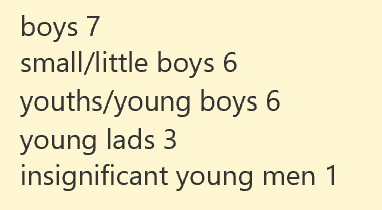
times each description is used across translationsvideos about topic
NOT CHILDREN
Some videos [see above right] claim that a “boy” is simply a young man who has not taken over a household yet. So these could be guys in their 20s who were verbally accosting Elisha. Adults by our standards– not just bratty elementary kids. But words like “guys” and “dudes” weren’t used then, and the original report does not list any specific ages, so we don’t know.
There is also the matter of their insult. They were yelling “Go Up, Baldy.” Likely in reference to Elisha’s “claim” that Elijah had gone up to be with the Lord. And the “baldy” part was likely an insult to imply that Elisha was not equal to Elijah (who was known to be quite hairy).
It seems likely that this group of young men in Bethel did not believe Elisha’s story about the disappearance of Elijah, just as the men in Jericho had not. If they believed that foul play had occurred, their taunting of “go up” should be interpreted as a threat–that whatever had happened to Elijah should happen to Elisha.
Secondary Defense:
Bears sent in self-defence. When confronted by a large group of hostile young men, one could certainly feel intimidated. Elisha should be justified in using his new blessing to prevent himself being lynched. Also, as mentioned in the following video clip, mauling does not necessarily equate to death. Elisha may not be guilty of murder even if the “controlled” bear attack was excessive force.
CORRECTION: Incident takes place in BETHEL, not Jericho.
Zac’s Modified Complaint:
God should be held liable for Elisha’s actions because he gave too much power to someone [who would choose to respond to the mob with curses and bearsrather than by using non-violent means].


 OgressHeroine
One thought on “2 Kings 2:23-25 – Z vs Elisha and God”